by LIVIA KHON, Ph.D.
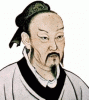
The Chuang-tzu (Zhuangzi) is the second major text of the Taoist tradition. It was compiled in the third century B.C.E. and follows in the footsteps of the best known and oldest of all Taoist texts, the Tao-te-ching (Daode jing, Book of the Tao and Its Potency), known by the name of its author, Laozi (Lao-tzu), which literally means "Old Master" or "Old Child."
There are many reasons to return to these ancient texts time and again, and especially to come back to the Chuang-tzu. The pure enjoyment of the stories, the vibrant humor of the tales, the fantastic aspects of reality -- they all give pleasure, release, exuberance. The intricacies of ancient Chinese culture as revealed in the text, with its complex social hierarchies, demanding ways of interaction, extensive death rituals and multiple layers of existence, from the creative power of "heaven" (a word indicating both the sky and the natural world at large) through gods and humans to animals and ghosts -- they all spark interest, transcend present limitations, open new ways of seeing and of being in the world. Last but not least, the complex philosophical and cosmological understanding of the universe, the vision of the individual as completely embedded in the greater flow of life, held and carried by the Way or Tao, the appreciation of the complete interconnectedness of all life, and the pervasive urging of the text to be who we are just as we are no matter where we are -- all these give power and inspiration, provide strength and determination, encourage the will to live to the fullest.
Unlike most renditions this version arranges the text by themes, beginning with the core question of the text: "In this world, is there such a thing as perfect happiness?" The answer is "certainly." But it takes work and a certain way of understanding self and reality combined with making clear and persistent efforts to actualize this understanding in body and life (although, according to Chuang-tzu, these efforts are nowhere near as organized as later Taoists would propose). Over a total of 14 chapters, the book then unravels key issues in Chuang-tzu's thought, from visions of the universe through understanding of fate, self, death and dreams, to ways of personal transformation with the help of various forms of conscious reprogramming and meditative practice which then lead to the best possible way of living in the world, exemplified in several different kinds of people and social situations.
Here are some examples:
"Life is the follower of death, and death is the beginning of life: who knows their inherent structure? Human life is nothing but an assemblance of vital energy. When it comes together, we come to life; when it scatters, we die. Since life and death thus closely follow each other, why whine about either? In this most essential aspect, the myriad things are one. They consider life as beautiful because it is spiritual and marvelous; they think of death as nasty because it is smelly and putrid. However, the smelly and putrid change again and become the spiritual and marvelous; the spiritual and marvelous change once more and turn smelly and putrid. Thus the saying, 'The entire world is but one vital energy.' Based on this, all sages value oneness" (Chapter 22).
Hui-tzu asked Chuang-tzu:
"Can a person really be without feelings?" -- "Of course." -- "A person without feelings, how can you call him human?" -- "Tao gave him visible appearance, heaven gave him bodily form. Why not call him human?" -- "But, if you call him human, how can he be without feelings?" -- "This is not what I mean when I speak of feelings. What I mean when I say he is without feelings is that the person does not allow likes and dislikes to enter and burden his social self, but always goes along with his inherent naturalness, never trying to improve on life" (Chapter 5).
Confucius said to Yen Hui:
"Oh, come on, Hui. Your family is poor and your house is dilapidated. Why don't you get a job?" -- "I don't want a job. I have eight acres of fields outside the city wall, enough for vegetables and grain. I also have an acre and a half of farm land nearby, which gives me enough silk and hemp. Strumming my zithers is enough to give me pleasure, studying Tao with you is enough to make me happy. I don't want a job" (Chapter 28).
Passages and stories like these demonstrate Chuang-tzu's approach to the best and most peaceful way of living in the world: see the bigger picture, stay within your comfort zone and do fully what gives you the most pleasure, ignore the demands of society and outside values in favor of inner wholeness and deep-seated contentment.
'Chuang-tzu: The Tao of Perfect Happiness' is published by SkyLight Paths.
http://www.huffingtonpost.com/livia-kohn-phd/chuangtzu-the-tao-of-perf_b_869404.html
The Chuang-tzu (Zhuangzi) is the second major text of the Taoist tradition. It was compiled in the third century B.C.E. and follows in the footsteps of the best known and oldest of all Taoist texts, the Tao-te-ching (Daode jing, Book of the Tao and Its Potency), known by the name of its author, Laozi (Lao-tzu), which literally means "Old Master" or "Old Child."
There are many reasons to return to these ancient texts time and again, and especially to come back to the Chuang-tzu. The pure enjoyment of the stories, the vibrant humor of the tales, the fantastic aspects of reality -- they all give pleasure, release, exuberance. The intricacies of ancient Chinese culture as revealed in the text, with its complex social hierarchies, demanding ways of interaction, extensive death rituals and multiple layers of existence, from the creative power of "heaven" (a word indicating both the sky and the natural world at large) through gods and humans to animals and ghosts -- they all spark interest, transcend present limitations, open new ways of seeing and of being in the world. Last but not least, the complex philosophical and cosmological understanding of the universe, the vision of the individual as completely embedded in the greater flow of life, held and carried by the Way or Tao, the appreciation of the complete interconnectedness of all life, and the pervasive urging of the text to be who we are just as we are no matter where we are -- all these give power and inspiration, provide strength and determination, encourage the will to live to the fullest.
Unlike most renditions this version arranges the text by themes, beginning with the core question of the text: "In this world, is there such a thing as perfect happiness?" The answer is "certainly." But it takes work and a certain way of understanding self and reality combined with making clear and persistent efforts to actualize this understanding in body and life (although, according to Chuang-tzu, these efforts are nowhere near as organized as later Taoists would propose). Over a total of 14 chapters, the book then unravels key issues in Chuang-tzu's thought, from visions of the universe through understanding of fate, self, death and dreams, to ways of personal transformation with the help of various forms of conscious reprogramming and meditative practice which then lead to the best possible way of living in the world, exemplified in several different kinds of people and social situations.
Here are some examples:
"Life is the follower of death, and death is the beginning of life: who knows their inherent structure? Human life is nothing but an assemblance of vital energy. When it comes together, we come to life; when it scatters, we die. Since life and death thus closely follow each other, why whine about either? In this most essential aspect, the myriad things are one. They consider life as beautiful because it is spiritual and marvelous; they think of death as nasty because it is smelly and putrid. However, the smelly and putrid change again and become the spiritual and marvelous; the spiritual and marvelous change once more and turn smelly and putrid. Thus the saying, 'The entire world is but one vital energy.' Based on this, all sages value oneness" (Chapter 22).
Hui-tzu asked Chuang-tzu:
"Can a person really be without feelings?" -- "Of course." -- "A person without feelings, how can you call him human?" -- "Tao gave him visible appearance, heaven gave him bodily form. Why not call him human?" -- "But, if you call him human, how can he be without feelings?" -- "This is not what I mean when I speak of feelings. What I mean when I say he is without feelings is that the person does not allow likes and dislikes to enter and burden his social self, but always goes along with his inherent naturalness, never trying to improve on life" (Chapter 5).
Confucius said to Yen Hui:
"Oh, come on, Hui. Your family is poor and your house is dilapidated. Why don't you get a job?" -- "I don't want a job. I have eight acres of fields outside the city wall, enough for vegetables and grain. I also have an acre and a half of farm land nearby, which gives me enough silk and hemp. Strumming my zithers is enough to give me pleasure, studying Tao with you is enough to make me happy. I don't want a job" (Chapter 28).
Passages and stories like these demonstrate Chuang-tzu's approach to the best and most peaceful way of living in the world: see the bigger picture, stay within your comfort zone and do fully what gives you the most pleasure, ignore the demands of society and outside values in favor of inner wholeness and deep-seated contentment.
'Chuang-tzu: The Tao of Perfect Happiness' is published by SkyLight Paths.
http://www.huffingtonpost.com/livia-kohn-phd/chuangtzu-the-tao-of-perf_b_869404.html