Changing trends in Sikh weddings and a special ‘Anand Karaj’ in Thailand
By Dya Singh
In my life and ‘travels’ I have attended, helped to conduct, and conducted, literally hundreds of ‘Anand Karaj’ (Sikh religious wedding) ceremonies since teenage-hood. I remember some beautiful ceremonies of yesteryears when the ‘lavan’ (four circumambulations by the couple around the Sri Guru Granth Sahib which is the hub of the ceremony) were the most important function and highlight of a Sikh wedding.
(Henceforth ‘lavan’ or ‘Anand Karaj’ refer to the aforementioned Sikh wedding ceremony. Other sub-ceremonies like ‘milni’, ‘mehndhi’, ‘ladies sangeet’, ‘segen’ are all cultural, non-spiritual attachments to the main ‘lavan’ ceremony.)
Our group was called upon to help plan and carry out an ‘Anand Karaj’ at the coastal resort village of Hua Hin, in Thailand on 9th July 2009. This ceremony was planned from the previous year.
BUT, first, let me explain why I considered it necessary to write about it.
It is my observation that the significance and meaning of the actual ‘lavan’ are today, generally, a mere formality and the remaining ‘merry-making’ and other, sometimes meaningless and outdated (but highly entertaining, with free booze and food for all attendees and a great opportunity to socialise) cultural ceremonies of a Sikh wedding have taken greater prominence.
I think the western ‘hens night’ and ‘bachelor party’ perhaps represent a more interesting modern phenomena. At least in that scenario the bridegroom comes in with a half-shaved head or a missing eyebrow – all part of the previous night’s merrymaking!!! (Normally the ‘hens party’ is a more ‘sober’ affair because the females are more concerned that their hair is done right, that the wedding dress is immaculate and she is there early, on time and looking at her best!) At least the ‘wedding ceremony’, (the ‘I do’s’ etc. whether in church or at a Registry) is the most important event! No so, the Sikh wedding, generally. A great many of the guests these days do not come to the actual ceremony but certainly turn up for the reception/s.
I attended a nephew’s ‘Anand Karaj’ in Vancouver a few years ago. The ‘so-called ‘mehndhi night’, the ‘sangeet’ night and the finale being the ‘reception’ were all far more significant in the eyes of almost all, while the Saturday morning ‘lavan’ ceremony was attended by a miniscule sangat. Yet again, on the day, the associated ceremonies like ‘milni’, ‘sagan’, ‘ring-exchange’ and ‘doli’ ceremonies were of greater prominence than the ‘lavan’ themselves.
The most prominent part of the ‘lavan’ was the haggling between the Gurdwara committee members with the bride-groom’s ‘representatives’ about how much the bride-groom’s party should contribute towards the Gurdwara as the bride’s party had contributed a certain amount and hopefully the bridegroom’s party would outdo them! The ‘lavan’ were so insignificant that I truly do not remember what happened as I was embroiled in the haggling over contributions towards the Gurdwara!!! The ‘highlight’ of the whole affair was a ‘reception’ at which I noticed that over 75% of the attendees had not bothered to come to the actual ‘lavan’ ceremony, the supposedly actual ‘wedding’ ceremony, that very morning!
Closer to home, in Malaysia, I have attended a number of Sikh weddings where once again attention to detail of the ‘ladys sangeet’ night, the ‘mehndhi night’ and ‘reception’ (two of these – one by the bride’s folks and one on the bridegroom’s side) take on a greater prominence compared to the preparation and carrying out of the ‘lavan’ ceremony.
Which ‘bhangra’ group is being hired; how the reception entertainment is going to run; and what type and quantity of alcoholic drinks are going to be served; is more important than how the ‘lavan’ ceremony is going to run. So much so, that in many instances the bridegroom has no clue as to what is expected of him during the ‘lavan’.
He is supposed to ‘lead’ his bride through four circumambulations around the Sri Guru Granth Sahib. More often than not, he gets towed around on the first circumambulation at least, like a donkey on a lead, being shown the way with the bride of course tied to him on another leash – the pela!!!
How often have we seen the bridegroom take off in the opposite direction during the first of the ‘lavan’ if not guided? I have, witnessed that on numerous occasions. In fact, as an observer I have actually taken bets as to whether he will either not know which way to move, when to move, or take off in the opposite direction! Some of these bridegrooms have barely seen the inside of a Gurdwara before! And I am talking of ‘Sikh’ bridegrooms! Perish the thought that anyone would have thought of a rehearsal!
I have witnessed Sikh weddings in UK held in smelly utility halls with the ‘lavan’ hastily done around a quickly rushed in Sri Guru Granth Sahib and the place take on the semblance of a raucious party even before the Sri Guru Granth Sahib is quickly rushed out and the booze starts flowing - and keeps going till about 4pm. when the ‘lunch’ is served! You can well imagine the state of some of the guests who have been let lose on free alcohol!
How often was my father, a ragi commanded to do the Asa Dhi Var (morning musical prayer) on the morning of the ‘lavan’ with no one, yes ‘no one’ there to listen? How often has an Anand Karaj ceremony started on time? Very few!
These ceremonies in Punjab (well the three I have witnessed) make the ceremonies overseas pale into insignificance! The Akal Takht management (the highest seat of authority for the Sikh religion), in its infinite wisdom came up with a Hukm Nama (edict) some years ago that a ‘lavan’ ceremony shall not take place in a building where the Sri Guru Granth Sahib would be disrespected due to alcohol being served afterwards or where alcohol is normally served ie. hotels and utility halls. No problem! The ‘Sikhs’ of Punjab came up with a very simple solution. The entrepreneurs built hundreds of ‘marriage palaces within striking distances of Gurdwaras! Below are my general observations after attending three such Sikh weddings in Ludhiana – the industrial capital of Punjab.
The bride’s party, who are the hosts in Sikh weddings turn up first – at the allocated marriage palace at about 9am. No other guests in sight yet. But first, let me give you a quick description of one of these marriage palaces.
It is normally in about one acre or more of land bought from a farmer, on a main trunk road. It is fenced with a cheap gaudy looking wall. The central structure is a tin shed with facades pasted on it to look like a Palace with plastic and colourful palm trees and bushes. Basically everything is plastic – even the palm trees, and come straight out of moulds. Sometimes there are multi-coloured ‘palms’! A friend told me that between Ludhiana and Mullanpur, a distance of barely 10 km. there are over one-hundred such marriage palaces! No Sikh there would dream of holding his daughters wedding in any place but a ‘marriage palace’. We know for a fact that ordinary Sikh farmers have been known to mortgage their souls to ensure that their daughters get a good send-off including gifts for the bridegroom and his party (dowry is a dirty word)!
OK, then at about 9.30am, the bride-groom’s party turns up. The two groups stand facing each other as a priest does a short standing prayer. This is called the ‘Milni’ (the ‘meeting’ ceremony). Some take off their shoes when this happens - others do not. No one is quite sure as to what the correct protocol is! Those guys and girls with newly permed and waved hair and for the occasion special hair-do’s shuffle around not quite sure whether they should cover their heads, which they are reluctant to, as that might put their expensive perms and hairdo’s out of place, or not. The bride’s party has gifts for a number of close relatives of the bride-groom’s party – sometimes quite lavish! At one of the weddings I attended and was present at the ‘milni’ ceremony, the bride’s party handed out very thick gold rings, expensive watches and gold bangles for each of about 20 from the opposite party! But, I digress. This is, by the way, an all male affair. The women are only involved in ensuring that the right ‘gifts’ went to the right man.
Guests start straggling in at about 10am. as the bride’s party makes a fuss of making sure that the guests – the bridegroom’s party is having a late breakfast with all sorts of sweetmeats and tea … some guests waste no time by going straight for the liquor stand… at 10am!
At about 11am, The bride and groom, their parents and about 10-15 close ‘invited’ relatives and friends ‘excuse’ themselves apologetically, and quickly climb into a few motor vehicles – not the decked up bridal vehicle (that is only to be used when the couple depart in the late evening) – and speed off towards the nearest Gurdwara where the priests and ragis (religious minstrels) await, to quickly send the couple through the ‘lavan’. After the Gurdwara management has been duly paid for, for their services, they all rush back to the marriage palace. Meanwhile, back at the marriage palace, the guests have been helping themselves to alcohol, the teetotalers of course have soft drinks and bottomless cups of ‘cha’ (Punjabi sweet, masala tea) and all sorts of food and tidbits.
So, between about 10am. till about 3pm. all the guests do, is eat, drink and chitchat. Then in the midst of all this eating and drinking, at about 1pm. like as if there is not enough to eat and drink already, a very elaborate ‘lunch’ is served! Of course once the couple are back from the Gurdwara, there is an elaborate ‘segen’ ceremony where every attendee – friends and relatives, come forward to congratulate the couple, wave some currency notes over their heads, place them in their laps and stand behind them to pose for photographs. Some are lugging around ‘wedding presents’ in gift boxes of all shapes and sizes.
At about 3-4pm., and sometimes later, if they are allowed to, and the bar is still open, one can see some of those attending staggering out of these marriage palaces in various states of inebriation – some even being carried out!
The main two parties have by now gone back to the bride’s parents’ house where preparations are made and elaborate goings-on, go on, to give the bride and groom a tearful send off – the ‘doli’ ceremony.
Before I finally tell you of the ceremony that we had the honour of conducting, let me firstly refer to a ceremony of which I was a part of, in Virginia, USA about ten years ago. Firstly no alcohol was involved whatsoever. Secondly, the ceremony was held in a well decorated and clean hall of the Merriot Hotel. The most poignant and moving part of the ceremony was after the ‘Anand Karaj’. The bridegroom assisted by the bride, did a ‘samapti’ (closing ceremony) of the Sri Guru Granth Sahib in the presence of the congregation and carried the ‘Guru’ out themselves before the congregation dispersed! That, in my book, is full reverence to the ‘Guru’!
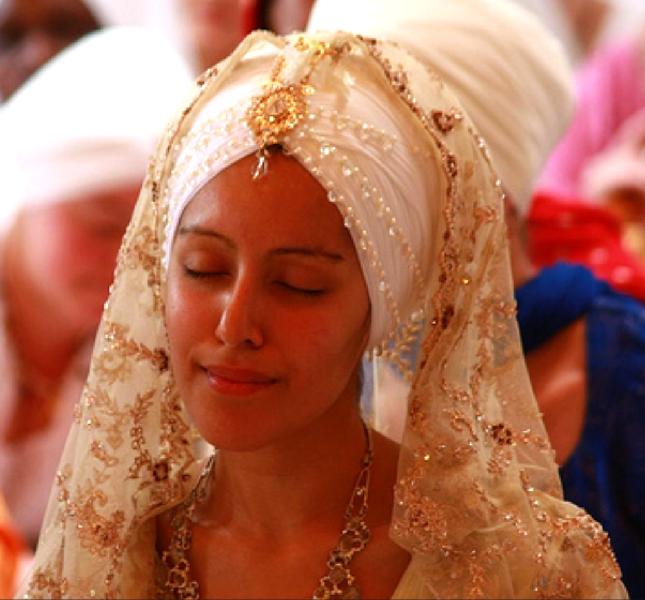
Now to the ceremony that I wish to tell you about … On 7-10 July 2009, our group was flown to Bangkok to conduct a Sikh wedding ceremony. A Sikh young lady was marrying an American ‘white’ young man. The planning with input from us, started in late 2008. This is how the ceremony went …
Guests started arriving on Monday 6 July. They were bussed out from Bangkok to the Hilton, Hua Hin – a coastal village about 250km. south from Bangkok, on the South China Sea coast, just north of Malaysia. Guests came from all over the world especially USA where the bride and groom and families now reside; Indonesia, Thailand and also about 30 guests from Kazakhstan where the bride’s father has business interests. Merrymaking started from that very night at various locations in Hua Hin with of course, great Thai and Indian food (including meat, if you wish to know) and alcohol!
Our team which included my music group members plus a good Sikh friend from Singapore arrived on Wednesday 8th. As planned, we were taken straight to a Sikh family’s penthouse – the top floor of the hotel they owned, in Bangkok from where we respectfully collected the Sri Guru Granth Sahib, and took Guru Ji by vehicle to Hua Hin accompanied to the sound of our recording of the ‘Sukhmani Sahib in kirtan’. At the Hilton, Hua Hin, Guru Ji was taken ceremoniously to Room No. 516 which had been specially prepared for Guru Ji’s stay. Our colleague from Singapore was appointed custodian sewadhar of Guru Ji. No party was held in that hotel that night. There was a final ‘reception’ for all guests at another location which wound up by 11pm. so that guests would all be fresh for the ‘ceremony’ the next morning.
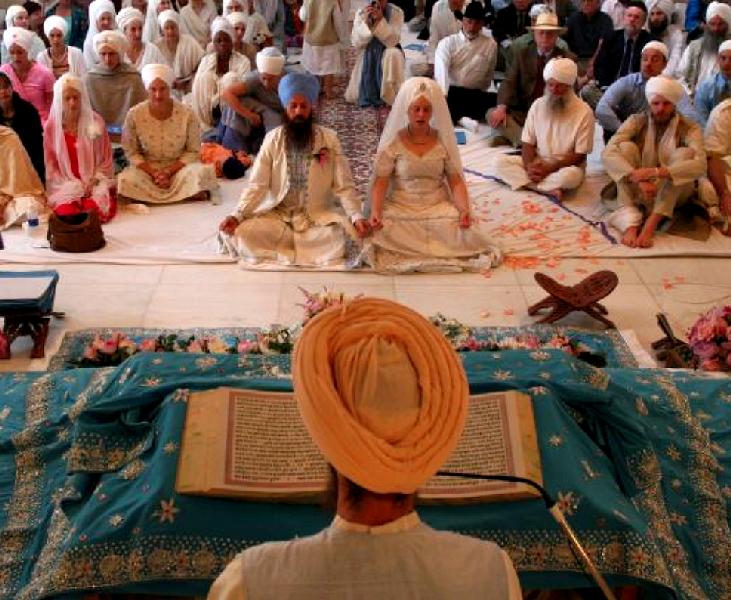
The conference hall at the Hilton was being decorated as we arrived. The special ‘palki sahib’ (canopy for the Sri Guru Granth Sahib) was built like a gazebo standing about 12 feet high and was roofed by fresh flowers and leaves. It looked absolutely beautiful!
That evening the bride and groom sat down with me to ‘go through’ with the ceremony so that they knew what to do and when – a rehearsal! Unheard of, in Sikh marriages!
At 7am, the next morning, ‘parkash’ (the opening of the Sri Guru Granth Sahib under the specially prepared canopy) was carried out. White sheets had been placed over the plush carpet and a ‘runway’ to the dais on which the Sri Guru Granth Sahib was laid open, had been prepared. The hall certainly looked as good as any Gurdwara I have seen!
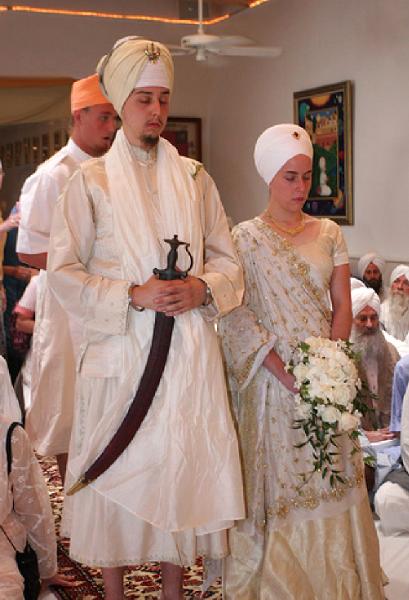
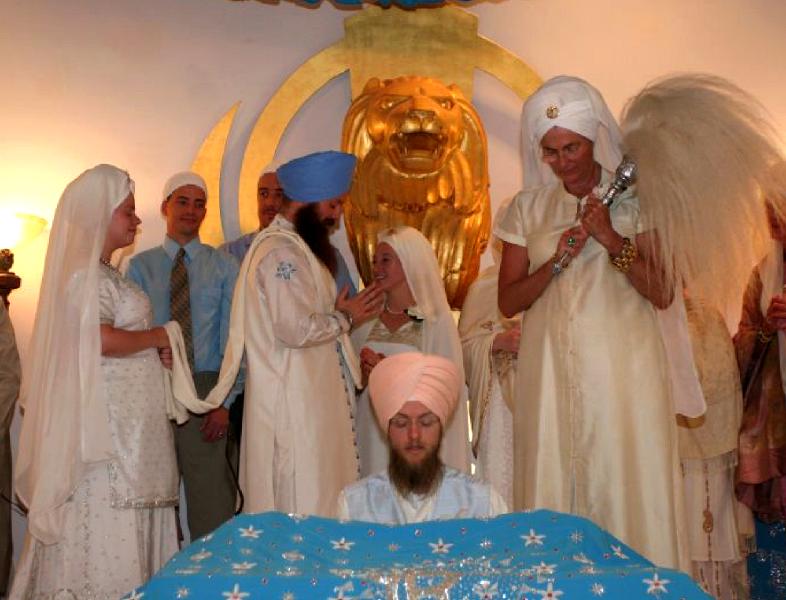
At 7.15am precisely, the young man, Ryan, arrived accompanied by his parents and a few other guests, and my colleague carried out the ‘Janam Sanskar’ (Sikh initial rite) ceremony. After the ‘amrit’ (holy nectar) had been administered to Ryan, the congregation was welcomed to partake of the ‘amrit’ and almost all did. The Hukmnama (a random passage from the Guru Ji) was read. It began with the word ‘Preet’. Ryan was duly informed that he could consult his intended parents-in-law for a choice of name for himself starting with the letter ‘P’ as Sikh protocol demands. He was very quick to request that he be named after his wife-to-be’s grandfather – Pritam Singh. He was gifted with the kirpan with which the ‘Janam Sanskar’ ceremony had been carried out and a kara (steel bangle), which was placed on his right wrist. He asked whether he could wear the kirpan for the Anand Karaj and we told him that we would be very pleased if he did!
By this time there was already a sangat of about 50 and we sang the Asa Dhi Var.
The Asa Dhi Var was completed by 9.30am. after which a break was announced so that everyone comes back fresh by 11am. for the big ceremony.
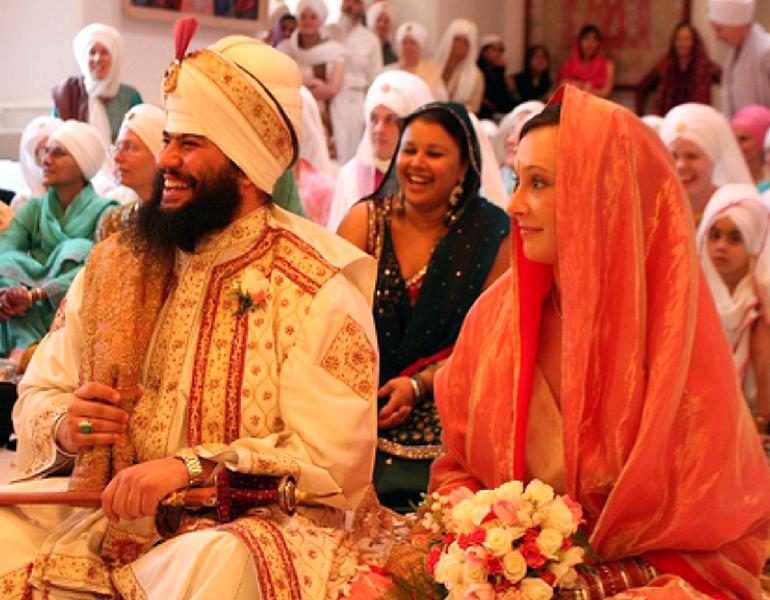
Kirtan was resumed by 10.30am. with naam simran as sangat arrived back in before 11am. At precisely 11am. the bride and groom arrived with close members of both families and within one hour the Anand Karaj was carried out in both Punjabi and English so that everyone understood the significance and importance of the ceremony. The ceremony was carried out in pin-drop silence with the congregation praying for the well-being of the couple as they went through the ‘lavan’.
Immediately after the ceremony, ‘samapti’ was carried out and Guru Ji was once again ceremoniously taken up to Room 516 accompanied by close relatives of both bride and groom.
As special gifts, all guests received a set of our new ‘Sukhmani Sahib in kirtan’ set and a simran cd.
At Lunch, no alcohol was served and there was no further ‘reception’ after that. All other ceremonies had been concluded the night before. The ‘lavan’ was the ‘finale’.
The Sri Guru Granth Sahib was delivered safely to the folks in Bangkok by our team, again in a respectful manner, that afternoon.
May Waheguru grant us more such meaningful ceremonies in the future…
Footnote:
I shall add my two cents worth on the eternal debate on inter-racial marriages…
I do not encourage them for obvious pitfalls just on the basis of this illusory emotion we term as ‘love’. It can also bring a great deal of pain and emotional upheaval within families. But, as it is a phenomena which is not going to go away, I believe that the couple should make a conscious decision as to which ‘faith’ or ‘religion’ or way of life they wish to live in and bring up their children, and accordingly have a ceremony within that faith or opt for a civil marriage. Having wedding ceremonies in two separate faiths just to satisfy ‘family’ makes a mockery of both faiths.
Let me finish on an amusing (probably painful) note. Recently I met a school friend after many many years. (He is a non-Muslim) He ‘fell in love’ with a Muslim lady and of course had to convert to Islam as Islamic law demands. He said the most painful (and probably trauma-filled) part was getting circumcised according to Malay/Muslim religious requirement and described it in some details – prayers and all, blood and all. BUT, he says, “my wife knows that I was willing to go through that ‘sacrifice’ and till this day loves me dearly”!
If you have enjoyed reading this, also look out for
1. Full Sukhmani Sahib with gutka - a must for every household!
2. Two double cd's of old albums of kirtan titled ' Gurbani Journey Vol ! & 2.. Each double cd is priced as a single cd.
3. Vintage Dya Singh - two live recordings which were released in very early years as cassettes. One with artistes from India and recorded in Delhi.
By Dya Singh
In my life and ‘travels’ I have attended, helped to conduct, and conducted, literally hundreds of ‘Anand Karaj’ (Sikh religious wedding) ceremonies since teenage-hood. I remember some beautiful ceremonies of yesteryears when the ‘lavan’ (four circumambulations by the couple around the Sri Guru Granth Sahib which is the hub of the ceremony) were the most important function and highlight of a Sikh wedding.
(Henceforth ‘lavan’ or ‘Anand Karaj’ refer to the aforementioned Sikh wedding ceremony. Other sub-ceremonies like ‘milni’, ‘mehndhi’, ‘ladies sangeet’, ‘segen’ are all cultural, non-spiritual attachments to the main ‘lavan’ ceremony.)
Our group was called upon to help plan and carry out an ‘Anand Karaj’ at the coastal resort village of Hua Hin, in Thailand on 9th July 2009. This ceremony was planned from the previous year.
BUT, first, let me explain why I considered it necessary to write about it.
It is my observation that the significance and meaning of the actual ‘lavan’ are today, generally, a mere formality and the remaining ‘merry-making’ and other, sometimes meaningless and outdated (but highly entertaining, with free booze and food for all attendees and a great opportunity to socialise) cultural ceremonies of a Sikh wedding have taken greater prominence.
I think the western ‘hens night’ and ‘bachelor party’ perhaps represent a more interesting modern phenomena. At least in that scenario the bridegroom comes in with a half-shaved head or a missing eyebrow – all part of the previous night’s merrymaking!!! (Normally the ‘hens party’ is a more ‘sober’ affair because the females are more concerned that their hair is done right, that the wedding dress is immaculate and she is there early, on time and looking at her best!) At least the ‘wedding ceremony’, (the ‘I do’s’ etc. whether in church or at a Registry) is the most important event! No so, the Sikh wedding, generally. A great many of the guests these days do not come to the actual ceremony but certainly turn up for the reception/s.
I attended a nephew’s ‘Anand Karaj’ in Vancouver a few years ago. The ‘so-called ‘mehndhi night’, the ‘sangeet’ night and the finale being the ‘reception’ were all far more significant in the eyes of almost all, while the Saturday morning ‘lavan’ ceremony was attended by a miniscule sangat. Yet again, on the day, the associated ceremonies like ‘milni’, ‘sagan’, ‘ring-exchange’ and ‘doli’ ceremonies were of greater prominence than the ‘lavan’ themselves.
The most prominent part of the ‘lavan’ was the haggling between the Gurdwara committee members with the bride-groom’s ‘representatives’ about how much the bride-groom’s party should contribute towards the Gurdwara as the bride’s party had contributed a certain amount and hopefully the bridegroom’s party would outdo them! The ‘lavan’ were so insignificant that I truly do not remember what happened as I was embroiled in the haggling over contributions towards the Gurdwara!!! The ‘highlight’ of the whole affair was a ‘reception’ at which I noticed that over 75% of the attendees had not bothered to come to the actual ‘lavan’ ceremony, the supposedly actual ‘wedding’ ceremony, that very morning!
Closer to home, in Malaysia, I have attended a number of Sikh weddings where once again attention to detail of the ‘ladys sangeet’ night, the ‘mehndhi night’ and ‘reception’ (two of these – one by the bride’s folks and one on the bridegroom’s side) take on a greater prominence compared to the preparation and carrying out of the ‘lavan’ ceremony.
Which ‘bhangra’ group is being hired; how the reception entertainment is going to run; and what type and quantity of alcoholic drinks are going to be served; is more important than how the ‘lavan’ ceremony is going to run. So much so, that in many instances the bridegroom has no clue as to what is expected of him during the ‘lavan’.
He is supposed to ‘lead’ his bride through four circumambulations around the Sri Guru Granth Sahib. More often than not, he gets towed around on the first circumambulation at least, like a donkey on a lead, being shown the way with the bride of course tied to him on another leash – the pela!!!
How often have we seen the bridegroom take off in the opposite direction during the first of the ‘lavan’ if not guided? I have, witnessed that on numerous occasions. In fact, as an observer I have actually taken bets as to whether he will either not know which way to move, when to move, or take off in the opposite direction! Some of these bridegrooms have barely seen the inside of a Gurdwara before! And I am talking of ‘Sikh’ bridegrooms! Perish the thought that anyone would have thought of a rehearsal!
I have witnessed Sikh weddings in UK held in smelly utility halls with the ‘lavan’ hastily done around a quickly rushed in Sri Guru Granth Sahib and the place take on the semblance of a raucious party even before the Sri Guru Granth Sahib is quickly rushed out and the booze starts flowing - and keeps going till about 4pm. when the ‘lunch’ is served! You can well imagine the state of some of the guests who have been let lose on free alcohol!
How often was my father, a ragi commanded to do the Asa Dhi Var (morning musical prayer) on the morning of the ‘lavan’ with no one, yes ‘no one’ there to listen? How often has an Anand Karaj ceremony started on time? Very few!
These ceremonies in Punjab (well the three I have witnessed) make the ceremonies overseas pale into insignificance! The Akal Takht management (the highest seat of authority for the Sikh religion), in its infinite wisdom came up with a Hukm Nama (edict) some years ago that a ‘lavan’ ceremony shall not take place in a building where the Sri Guru Granth Sahib would be disrespected due to alcohol being served afterwards or where alcohol is normally served ie. hotels and utility halls. No problem! The ‘Sikhs’ of Punjab came up with a very simple solution. The entrepreneurs built hundreds of ‘marriage palaces within striking distances of Gurdwaras! Below are my general observations after attending three such Sikh weddings in Ludhiana – the industrial capital of Punjab.
The bride’s party, who are the hosts in Sikh weddings turn up first – at the allocated marriage palace at about 9am. No other guests in sight yet. But first, let me give you a quick description of one of these marriage palaces.
It is normally in about one acre or more of land bought from a farmer, on a main trunk road. It is fenced with a cheap gaudy looking wall. The central structure is a tin shed with facades pasted on it to look like a Palace with plastic and colourful palm trees and bushes. Basically everything is plastic – even the palm trees, and come straight out of moulds. Sometimes there are multi-coloured ‘palms’! A friend told me that between Ludhiana and Mullanpur, a distance of barely 10 km. there are over one-hundred such marriage palaces! No Sikh there would dream of holding his daughters wedding in any place but a ‘marriage palace’. We know for a fact that ordinary Sikh farmers have been known to mortgage their souls to ensure that their daughters get a good send-off including gifts for the bridegroom and his party (dowry is a dirty word)!
OK, then at about 9.30am, the bride-groom’s party turns up. The two groups stand facing each other as a priest does a short standing prayer. This is called the ‘Milni’ (the ‘meeting’ ceremony). Some take off their shoes when this happens - others do not. No one is quite sure as to what the correct protocol is! Those guys and girls with newly permed and waved hair and for the occasion special hair-do’s shuffle around not quite sure whether they should cover their heads, which they are reluctant to, as that might put their expensive perms and hairdo’s out of place, or not. The bride’s party has gifts for a number of close relatives of the bride-groom’s party – sometimes quite lavish! At one of the weddings I attended and was present at the ‘milni’ ceremony, the bride’s party handed out very thick gold rings, expensive watches and gold bangles for each of about 20 from the opposite party! But, I digress. This is, by the way, an all male affair. The women are only involved in ensuring that the right ‘gifts’ went to the right man.
Guests start straggling in at about 10am. as the bride’s party makes a fuss of making sure that the guests – the bridegroom’s party is having a late breakfast with all sorts of sweetmeats and tea … some guests waste no time by going straight for the liquor stand… at 10am!
At about 11am, The bride and groom, their parents and about 10-15 close ‘invited’ relatives and friends ‘excuse’ themselves apologetically, and quickly climb into a few motor vehicles – not the decked up bridal vehicle (that is only to be used when the couple depart in the late evening) – and speed off towards the nearest Gurdwara where the priests and ragis (religious minstrels) await, to quickly send the couple through the ‘lavan’. After the Gurdwara management has been duly paid for, for their services, they all rush back to the marriage palace. Meanwhile, back at the marriage palace, the guests have been helping themselves to alcohol, the teetotalers of course have soft drinks and bottomless cups of ‘cha’ (Punjabi sweet, masala tea) and all sorts of food and tidbits.
So, between about 10am. till about 3pm. all the guests do, is eat, drink and chitchat. Then in the midst of all this eating and drinking, at about 1pm. like as if there is not enough to eat and drink already, a very elaborate ‘lunch’ is served! Of course once the couple are back from the Gurdwara, there is an elaborate ‘segen’ ceremony where every attendee – friends and relatives, come forward to congratulate the couple, wave some currency notes over their heads, place them in their laps and stand behind them to pose for photographs. Some are lugging around ‘wedding presents’ in gift boxes of all shapes and sizes.
At about 3-4pm., and sometimes later, if they are allowed to, and the bar is still open, one can see some of those attending staggering out of these marriage palaces in various states of inebriation – some even being carried out!
The main two parties have by now gone back to the bride’s parents’ house where preparations are made and elaborate goings-on, go on, to give the bride and groom a tearful send off – the ‘doli’ ceremony.
Before I finally tell you of the ceremony that we had the honour of conducting, let me firstly refer to a ceremony of which I was a part of, in Virginia, USA about ten years ago. Firstly no alcohol was involved whatsoever. Secondly, the ceremony was held in a well decorated and clean hall of the Merriot Hotel. The most poignant and moving part of the ceremony was after the ‘Anand Karaj’. The bridegroom assisted by the bride, did a ‘samapti’ (closing ceremony) of the Sri Guru Granth Sahib in the presence of the congregation and carried the ‘Guru’ out themselves before the congregation dispersed! That, in my book, is full reverence to the ‘Guru’!
Now to the ceremony that I wish to tell you about … On 7-10 July 2009, our group was flown to Bangkok to conduct a Sikh wedding ceremony. A Sikh young lady was marrying an American ‘white’ young man. The planning with input from us, started in late 2008. This is how the ceremony went …
Guests started arriving on Monday 6 July. They were bussed out from Bangkok to the Hilton, Hua Hin – a coastal village about 250km. south from Bangkok, on the South China Sea coast, just north of Malaysia. Guests came from all over the world especially USA where the bride and groom and families now reside; Indonesia, Thailand and also about 30 guests from Kazakhstan where the bride’s father has business interests. Merrymaking started from that very night at various locations in Hua Hin with of course, great Thai and Indian food (including meat, if you wish to know) and alcohol!
Our team which included my music group members plus a good Sikh friend from Singapore arrived on Wednesday 8th. As planned, we were taken straight to a Sikh family’s penthouse – the top floor of the hotel they owned, in Bangkok from where we respectfully collected the Sri Guru Granth Sahib, and took Guru Ji by vehicle to Hua Hin accompanied to the sound of our recording of the ‘Sukhmani Sahib in kirtan’. At the Hilton, Hua Hin, Guru Ji was taken ceremoniously to Room No. 516 which had been specially prepared for Guru Ji’s stay. Our colleague from Singapore was appointed custodian sewadhar of Guru Ji. No party was held in that hotel that night. There was a final ‘reception’ for all guests at another location which wound up by 11pm. so that guests would all be fresh for the ‘ceremony’ the next morning.
The conference hall at the Hilton was being decorated as we arrived. The special ‘palki sahib’ (canopy for the Sri Guru Granth Sahib) was built like a gazebo standing about 12 feet high and was roofed by fresh flowers and leaves. It looked absolutely beautiful!
That evening the bride and groom sat down with me to ‘go through’ with the ceremony so that they knew what to do and when – a rehearsal! Unheard of, in Sikh marriages!
At 7am, the next morning, ‘parkash’ (the opening of the Sri Guru Granth Sahib under the specially prepared canopy) was carried out. White sheets had been placed over the plush carpet and a ‘runway’ to the dais on which the Sri Guru Granth Sahib was laid open, had been prepared. The hall certainly looked as good as any Gurdwara I have seen!
At 7.15am precisely, the young man, Ryan, arrived accompanied by his parents and a few other guests, and my colleague carried out the ‘Janam Sanskar’ (Sikh initial rite) ceremony. After the ‘amrit’ (holy nectar) had been administered to Ryan, the congregation was welcomed to partake of the ‘amrit’ and almost all did. The Hukmnama (a random passage from the Guru Ji) was read. It began with the word ‘Preet’. Ryan was duly informed that he could consult his intended parents-in-law for a choice of name for himself starting with the letter ‘P’ as Sikh protocol demands. He was very quick to request that he be named after his wife-to-be’s grandfather – Pritam Singh. He was gifted with the kirpan with which the ‘Janam Sanskar’ ceremony had been carried out and a kara (steel bangle), which was placed on his right wrist. He asked whether he could wear the kirpan for the Anand Karaj and we told him that we would be very pleased if he did!
By this time there was already a sangat of about 50 and we sang the Asa Dhi Var.
The Asa Dhi Var was completed by 9.30am. after which a break was announced so that everyone comes back fresh by 11am. for the big ceremony.
Kirtan was resumed by 10.30am. with naam simran as sangat arrived back in before 11am. At precisely 11am. the bride and groom arrived with close members of both families and within one hour the Anand Karaj was carried out in both Punjabi and English so that everyone understood the significance and importance of the ceremony. The ceremony was carried out in pin-drop silence with the congregation praying for the well-being of the couple as they went through the ‘lavan’.
Immediately after the ceremony, ‘samapti’ was carried out and Guru Ji was once again ceremoniously taken up to Room 516 accompanied by close relatives of both bride and groom.
As special gifts, all guests received a set of our new ‘Sukhmani Sahib in kirtan’ set and a simran cd.
At Lunch, no alcohol was served and there was no further ‘reception’ after that. All other ceremonies had been concluded the night before. The ‘lavan’ was the ‘finale’.
The Sri Guru Granth Sahib was delivered safely to the folks in Bangkok by our team, again in a respectful manner, that afternoon.
May Waheguru grant us more such meaningful ceremonies in the future…
Footnote:
I shall add my two cents worth on the eternal debate on inter-racial marriages…
I do not encourage them for obvious pitfalls just on the basis of this illusory emotion we term as ‘love’. It can also bring a great deal of pain and emotional upheaval within families. But, as it is a phenomena which is not going to go away, I believe that the couple should make a conscious decision as to which ‘faith’ or ‘religion’ or way of life they wish to live in and bring up their children, and accordingly have a ceremony within that faith or opt for a civil marriage. Having wedding ceremonies in two separate faiths just to satisfy ‘family’ makes a mockery of both faiths.
Let me finish on an amusing (probably painful) note. Recently I met a school friend after many many years. (He is a non-Muslim) He ‘fell in love’ with a Muslim lady and of course had to convert to Islam as Islamic law demands. He said the most painful (and probably trauma-filled) part was getting circumcised according to Malay/Muslim religious requirement and described it in some details – prayers and all, blood and all. BUT, he says, “my wife knows that I was willing to go through that ‘sacrifice’ and till this day loves me dearly”!
If you have enjoyed reading this, also look out for
1. Full Sukhmani Sahib with gutka - a must for every household!
2. Two double cd's of old albums of kirtan titled ' Gurbani Journey Vol ! & 2.. Each double cd is priced as a single cd.
3. Vintage Dya Singh - two live recordings which were released in very early years as cassettes. One with artistes from India and recorded in Delhi.




 But also for adults who convert to Sikhism and want a Sikh name.