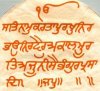
The Japuji of Guru Nanak : Its Doctrinal Basis
Sirdar Kapur Singh
The Japu is the first text included in Guru Granth Sahib. It is held by many scholars that the Japu contains the main thesis of the Sikh religion and that the rest of the Guru Granth is merely exegetic. This is the reason why a careful study of the Japu is necessary, before anything else, for those who would understand Sikhism and the Sikh movement.
Some modern readers, however, experience considerable difficulty in following the meaning and significance of such texts as the Japu for the reason that they are not well acquainted with the ancient spiritual traditions of India, while the Japu assumes such an acquaintance.
The Vedas, by common agreement, contain the most ancient religious and philosophical lore of mankind which has been the corner-stone of all religious and metaphysical thought of India during the last three or four millennia.
Gautam, the Buddha, when preaching his precepts twenty-five hundred years ago, declared as the Dhammapada, records, ‘Esho dhammam sandatanam’ - “What I preach is the ancient Truth.”
The ancient religious lore of India is collectively called the Veda, and the Veda, therefore, is very old indeed. The ontological status of the Veda, according to the Mimansa, which is Vadanga, a limb of the Veda, is that the Veda is God-inspired and eternal. What does this claim mean? The Nyaya Sutra of Gautam, the Rishi, which is another Vadanga, recognises four categories of epistemology, that is, the means whereby knowledge is obtainable: Pratakshya (sense perception), Anuman (inference), Upman (analogy) and Sabd (testimony).
Pratakshya furnishes the material with which the physical sciences deal, while Anuman and Upman, do not independently furnish facts. They can only examine and analyse the facts furnished by the Pratyakshya.
The material of the Sabd are the regions inaccessible to the normal human senses, it being taken as demonstrable that such regions exist. The man who categorically denies the existence of such regions is a Nastaka - denier. With him there is no further argument in the ancient Indian philosophy. He is the Manmukh, in the Sikh terminology - the man who refuses to go beyond the normal human sense-perception, in contradistinction to the Gurmukh who accepts the Sabd, the testimony of the Guru.
The Veda, technically, is the Sabd, containing, in verbal sounds, the facts pertaining to regions beyond the range of human sense-perception.
“Mysticism,” “numenon,” etc. - vaguely signify, in the West, the kind of knowledge which is the subject matter of Sabd.
In India, the Veda, the repository of the Sabd has been commonly identified with the textual records known as the Rig Veda, the Sam Veda, the Atharva and the Yajur Veda. Also, the numerous Upanishads are treated as the last chapter of the Veda and therefore it is called the Vedanta.
This Veda, that is, the Veda understood in this specific sense, has six limbs, six Vedangs, the knowledge of which is necessary for understanding the Veda. These limbs are prosody, grammar, etymology, pronunciation, astrology and the ritual.
The facts given in the Veda are not perceived or formulated through human reason but are believed to have been revealed to men of extra-sensitivity - the Rishis - and, therefore, the Veda is Sruti.. revealed knowledge, as distinct from the Smriti.. knowledge derived through sense - perception and reasoning. The Veda is its own proof of its truth; it is what is technically called svatah-praman.
Gautam, the Buddha, twenty-five centuries ago repudiated the claim and validity of this Veda in its specific sense and he also denied the validity of Sabd as a source of true knowledge. Buddhi, the disciplined and enlightened reason, was the source of all the truths that Gautam, the Buddha, preached.
As is recorded in the Mahaparnib-bansuttanta of the Pali Dighnikaya, when Subhadra, the Brahmin philosopher, met the Buddha at the banks of the river Hiranayvati, at the time when the Buddha was about to pass away, in answer to the question as to whether there were any other truths beyond those mentioned in the Veda texts, the Buddha replied:
“This is not the time for such discussions. To true wisdom, there is only one way, the path laid down by me... O, Subhadra, I do not speak to you of things I have not experienced. Since I was 29 years old, until now, I have striven after pure and perfect wisdom....”
It is for this reason that Gautam, the Buddha, is described as a Nastik .. a denier, an heretic.. in the Indian writings.
The disappearance of Buddhism from its native soil about fifteen hundred years ago is synchronous with the re-assertion of, the doctrine of Sabd and the identification of the Sabd with the Veda in its specific sense. This is the corpus of the ancient Sanskrit texts, the four Vedas and Upanishads.
It also includes the aphorisms called Brahmsutra of Badrayan, the Rishi. All the mighty religious currents of Hindu thought of the middle ages originated from the interpretations of, and commentaries on, these Brahmsutras by such outstanding figures as Sankara, Ramanuja, and Madhava, the three great Acharyas of Hinduism.
These Acharyas are the founders of the great philosophical systems known as Advait, Vasisht Advait and Dwait. These philosophic system became the foundation of the great Bhakti movement presided over by such mighty figures as Chaitanya, Tukaram, Jnaneswar, Tulsi and Kabir down to Vivekananda and Ramatirath. It may truly be asserted that all these philosophical systems, the great Bhakti movement in all its nuances, the whole of this philosophico-religious thought and activity are based on logic and grammar, the Bhashyas of the Brahmsutras.
Two thousand years after Gautam, the Buddha, Guru Nanak is a milestone in the philosophical and cultural life of India comparable in principle to the phenomenon of the revelation of the Vedic texts and the formulation of the psychological discipline of Buddhism.
Guru Nanak proclaims the validity of the doctrine of the Sabd with a certain modification, and claims that the Sabd testimony which he adduces is independent of the ancient scriptural texts called the Veda, both in its genesis and validity.
Beyond that, he does not explicitly go. He does not repudiate the truth enshrined in this specific Veda, as Gautam, the Buddha did.
Unlike Gautam, the Buddha, Guru Nanak does not repudiate the validity of the Sabd testimony. Like Gautam, the Buddha, he asserts that the springs of Truth have not dried up forever for mankind, and denies that mortal may do no more that interpret, with the aid of logic and grammar, the truths stratified in the ancient texts.
With regard to the genesis of the Sabd testimony, the Guru asserts the human beings are capable, each one of us, of experiencing the truths which he speaks, provided he submits himself to a sustained rigorous physical and spiritual discipline and provided certain extra-terrestrial condition called the Power of Grace, are favourable to him. The last hymn of the Japu clearly enunciates this modified doctrine of Sabd.
This modified doctrine is of tremendous significance to the religious thought of India and, indeed, the whole of mankind. It preserves the transcendental character of Truth but substitutes the concept of a growing knowledge of this Truth within the ken of human minds. Its primary interest is centred around the problem of the quality of living.
This doctrine of Guru Nanak is of such a basic philosophic nature that it would be difficult to conceive of any historical or philosophic discovery which would seriously affect it. The essential teaching of Guru Nanak, the essence of Sikhism, therefore, has nothing to fear from the two basic and revolutionary activities of the human mind, or, more precisely, the modern Western mind, higher criticism and scientific investigation.
Higher criticism consists of the examination of previous ideas and their alleged authorities, while scientific investigation examines all things dispassionately and objectively, assuming nothing and testing everything.
Guru Nanak bases his testimony on previous authority and concedes the possibility of the truths that he reveals being tested by human mind, provided certain experimental conditions are fulfilled.
The Japuji has thirty-eight hymns or Pauris, i.e. the stairs, containing a systematic and complete statement of the basic philosophy of Guru Nanak. all the hymns of the Japu are metrical, on the pattern of Rig Veda, with a severity of expression and economy of words, making the stanzas related brothers of the ancient Sanskrit Sutras. This has made the Japu the most difficult of Guru Nanak’s compositions to understand.
The line which forms the metrical unit consists of varying number of syllables and in each line the number of syllables is constant in all the hymns. The concluding lines of a hymn are often of a different syllabic length. The metres, like those of classical Sanskrit, have a quantitative rhythm in which long and short syllables almost alternate. The rhythm of the last four or five syllables is rigidly determined. In their structure, they come half-way between the metre of the Zend Avesta where the principle is the number of syllables only, and the classical Sanskrit in which the quantity of every single syllable is fixed in every line. The Epilogue, the last Sloka, however, is an exception to this rule.
Sirdar Kapur Singh
The Japu is the first text included in Guru Granth Sahib. It is held by many scholars that the Japu contains the main thesis of the Sikh religion and that the rest of the Guru Granth is merely exegetic. This is the reason why a careful study of the Japu is necessary, before anything else, for those who would understand Sikhism and the Sikh movement.
Some modern readers, however, experience considerable difficulty in following the meaning and significance of such texts as the Japu for the reason that they are not well acquainted with the ancient spiritual traditions of India, while the Japu assumes such an acquaintance.
The Vedas, by common agreement, contain the most ancient religious and philosophical lore of mankind which has been the corner-stone of all religious and metaphysical thought of India during the last three or four millennia.
Gautam, the Buddha, when preaching his precepts twenty-five hundred years ago, declared as the Dhammapada, records, ‘Esho dhammam sandatanam’ - “What I preach is the ancient Truth.”
The ancient religious lore of India is collectively called the Veda, and the Veda, therefore, is very old indeed. The ontological status of the Veda, according to the Mimansa, which is Vadanga, a limb of the Veda, is that the Veda is God-inspired and eternal. What does this claim mean? The Nyaya Sutra of Gautam, the Rishi, which is another Vadanga, recognises four categories of epistemology, that is, the means whereby knowledge is obtainable: Pratakshya (sense perception), Anuman (inference), Upman (analogy) and Sabd (testimony).
Pratakshya furnishes the material with which the physical sciences deal, while Anuman and Upman, do not independently furnish facts. They can only examine and analyse the facts furnished by the Pratyakshya.
The material of the Sabd are the regions inaccessible to the normal human senses, it being taken as demonstrable that such regions exist. The man who categorically denies the existence of such regions is a Nastaka - denier. With him there is no further argument in the ancient Indian philosophy. He is the Manmukh, in the Sikh terminology - the man who refuses to go beyond the normal human sense-perception, in contradistinction to the Gurmukh who accepts the Sabd, the testimony of the Guru.
The Veda, technically, is the Sabd, containing, in verbal sounds, the facts pertaining to regions beyond the range of human sense-perception.
“Mysticism,” “numenon,” etc. - vaguely signify, in the West, the kind of knowledge which is the subject matter of Sabd.
In India, the Veda, the repository of the Sabd has been commonly identified with the textual records known as the Rig Veda, the Sam Veda, the Atharva and the Yajur Veda. Also, the numerous Upanishads are treated as the last chapter of the Veda and therefore it is called the Vedanta.
This Veda, that is, the Veda understood in this specific sense, has six limbs, six Vedangs, the knowledge of which is necessary for understanding the Veda. These limbs are prosody, grammar, etymology, pronunciation, astrology and the ritual.
The facts given in the Veda are not perceived or formulated through human reason but are believed to have been revealed to men of extra-sensitivity - the Rishis - and, therefore, the Veda is Sruti.. revealed knowledge, as distinct from the Smriti.. knowledge derived through sense - perception and reasoning. The Veda is its own proof of its truth; it is what is technically called svatah-praman.
Gautam, the Buddha, twenty-five centuries ago repudiated the claim and validity of this Veda in its specific sense and he also denied the validity of Sabd as a source of true knowledge. Buddhi, the disciplined and enlightened reason, was the source of all the truths that Gautam, the Buddha, preached.
As is recorded in the Mahaparnib-bansuttanta of the Pali Dighnikaya, when Subhadra, the Brahmin philosopher, met the Buddha at the banks of the river Hiranayvati, at the time when the Buddha was about to pass away, in answer to the question as to whether there were any other truths beyond those mentioned in the Veda texts, the Buddha replied:
“This is not the time for such discussions. To true wisdom, there is only one way, the path laid down by me... O, Subhadra, I do not speak to you of things I have not experienced. Since I was 29 years old, until now, I have striven after pure and perfect wisdom....”
It is for this reason that Gautam, the Buddha, is described as a Nastik .. a denier, an heretic.. in the Indian writings.
The disappearance of Buddhism from its native soil about fifteen hundred years ago is synchronous with the re-assertion of, the doctrine of Sabd and the identification of the Sabd with the Veda in its specific sense. This is the corpus of the ancient Sanskrit texts, the four Vedas and Upanishads.
It also includes the aphorisms called Brahmsutra of Badrayan, the Rishi. All the mighty religious currents of Hindu thought of the middle ages originated from the interpretations of, and commentaries on, these Brahmsutras by such outstanding figures as Sankara, Ramanuja, and Madhava, the three great Acharyas of Hinduism.
These Acharyas are the founders of the great philosophical systems known as Advait, Vasisht Advait and Dwait. These philosophic system became the foundation of the great Bhakti movement presided over by such mighty figures as Chaitanya, Tukaram, Jnaneswar, Tulsi and Kabir down to Vivekananda and Ramatirath. It may truly be asserted that all these philosophical systems, the great Bhakti movement in all its nuances, the whole of this philosophico-religious thought and activity are based on logic and grammar, the Bhashyas of the Brahmsutras.
Two thousand years after Gautam, the Buddha, Guru Nanak is a milestone in the philosophical and cultural life of India comparable in principle to the phenomenon of the revelation of the Vedic texts and the formulation of the psychological discipline of Buddhism.
Guru Nanak proclaims the validity of the doctrine of the Sabd with a certain modification, and claims that the Sabd testimony which he adduces is independent of the ancient scriptural texts called the Veda, both in its genesis and validity.
Beyond that, he does not explicitly go. He does not repudiate the truth enshrined in this specific Veda, as Gautam, the Buddha did.
Unlike Gautam, the Buddha, Guru Nanak does not repudiate the validity of the Sabd testimony. Like Gautam, the Buddha, he asserts that the springs of Truth have not dried up forever for mankind, and denies that mortal may do no more that interpret, with the aid of logic and grammar, the truths stratified in the ancient texts.
With regard to the genesis of the Sabd testimony, the Guru asserts the human beings are capable, each one of us, of experiencing the truths which he speaks, provided he submits himself to a sustained rigorous physical and spiritual discipline and provided certain extra-terrestrial condition called the Power of Grace, are favourable to him. The last hymn of the Japu clearly enunciates this modified doctrine of Sabd.
This modified doctrine is of tremendous significance to the religious thought of India and, indeed, the whole of mankind. It preserves the transcendental character of Truth but substitutes the concept of a growing knowledge of this Truth within the ken of human minds. Its primary interest is centred around the problem of the quality of living.
This doctrine of Guru Nanak is of such a basic philosophic nature that it would be difficult to conceive of any historical or philosophic discovery which would seriously affect it. The essential teaching of Guru Nanak, the essence of Sikhism, therefore, has nothing to fear from the two basic and revolutionary activities of the human mind, or, more precisely, the modern Western mind, higher criticism and scientific investigation.
Higher criticism consists of the examination of previous ideas and their alleged authorities, while scientific investigation examines all things dispassionately and objectively, assuming nothing and testing everything.
Guru Nanak bases his testimony on previous authority and concedes the possibility of the truths that he reveals being tested by human mind, provided certain experimental conditions are fulfilled.
The Japuji has thirty-eight hymns or Pauris, i.e. the stairs, containing a systematic and complete statement of the basic philosophy of Guru Nanak. all the hymns of the Japu are metrical, on the pattern of Rig Veda, with a severity of expression and economy of words, making the stanzas related brothers of the ancient Sanskrit Sutras. This has made the Japu the most difficult of Guru Nanak’s compositions to understand.
The line which forms the metrical unit consists of varying number of syllables and in each line the number of syllables is constant in all the hymns. The concluding lines of a hymn are often of a different syllabic length. The metres, like those of classical Sanskrit, have a quantitative rhythm in which long and short syllables almost alternate. The rhythm of the last four or five syllables is rigidly determined. In their structure, they come half-way between the metre of the Zend Avesta where the principle is the number of syllables only, and the classical Sanskrit in which the quantity of every single syllable is fixed in every line. The Epilogue, the last Sloka, however, is an exception to this rule.