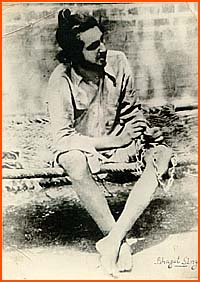
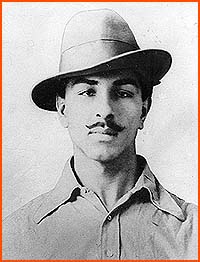
[FONT=Geneva, Arial, Sans-serif]Dear Friends,[/FONT]
[FONT=Geneva, Arial, Sans-serif]On my reading of Indian history and the independence struggle one of the people that I have most time for is Bhagat Singh[/FONT]
[FONT=Geneva, Arial, Sans-serif]Martyed at the age of 23 with Sukhdev Thapar and Hariram Rajguru his name remains as a shining example of a shaheed [/FONT]
[FONT=Geneva, Arial, Sans-serif]I note howver that recently the neo- Sikhs have begin to appropriate his name - many books and gurudwaras are showing his paintings and pics as a 'keshdhari' Sikh whilst in jail- Some have even coined a story that whilst in jail he reverted from hsi atheist beleifs and became a 'true beleiver'[/FONT]
[FONT=Geneva, Arial, Sans-serif]The facts are otherwise:[/FONT]
[FONT=Geneva, Arial, Sans-serif](1) His own letters and writings reflect his non beleif in God[/FONT]
[FONT=Geneva, Arial, Sans-serif](2) His family who visited him in jail attest that he did not become a keshdhari on his martyrdom[/FONT]
[FONT=Geneva, Arial, Sans-serif](3) as do the eyewitnessess in jail[/FONT]
[FONT=Geneva, Arial, Sans-serif]It is impossible to beleive that such a heroic and ideological man , willing to lay down his life for his principles (even if we dont agree with all of them) would at the last instant turn back on those very beleifs [/FONT]
[FONT=Geneva, Arial, Sans-serif]Even is he was a socialist/communist does it make his sacrifice any less ?[/FONT]
[FONT=Geneva, Arial, Sans-serif]Most of the violent struggle against the British was left leaning and groups like the RSS , the Akalis et all did little for the independence struggle in comparison.[/FONT]
[FONT=Geneva, Arial, Sans-serif]- -[/FONT]
[FONT=Geneva, Arial, Sans-serif]- -[/FONT]
[FONT=Geneva, Arial, Sans-serif]Something that might interest you...[/FONT]
[FONT=Geneva, Arial, Sans-serif]Chech-out Bhagat Singh's photo on this website supported by Shahid Bhagat Singh Research Committee, Ludhiana...[/FONT]
[FONT=Geneva, Arial, Sans-serif]http://www.shahidbhagatsingh.org/sbsphotos.asp[/FONT]
[FONT=Geneva, Arial, Sans-serif]Isn't this laughable ?? planting a beard on bhagat singh...pretty shoddy job too...[/FONT]
[FONT=Geneva, Arial, Sans-serif]Why are the Sikh in the west lying to their own children ?? Grow up guys lest you make yourselves the laughing stock of the world.[/FONT]
[FONT=Geneva, Arial, Sans-serif]- -[/FONT]
[FONT=Geneva, Arial, Sans-serif]- -[/FONT]
[FONT=Geneva, Arial, Sans-serif]Putting up pictures of Bhagat Singh in Guru-dwara's is an insult to the Guru-dwara as well as to the memory of a great martyr like Bhagat Singh. Those who do that respect neither Sikhism nor Bhagat. He should be respected for what he was and what he stood for. And he did stand for what he believed in till his last breath.[/FONT]
[FONT=Geneva, Arial, Sans-serif]It's not just Bhagat Singh the Akali and Neo-Sikh clowns are messing with. Look at how they treat the Dasam-Granth. Almost as if it doesn't exist. It might not be taken as a religious doctrine coz' Sikhism itself promoted scepticism through it's Guru's but the fact that it was written and that too by the Dasam-Pitaah is reason enough for it to be read. By all who believe in him. Or want to.[/FONT]
[FONT=Geneva, Arial, Sans-serif]There has been considerable controversy surrounding some of the writings attributed to him, with the suggestion being made that they fail to fit into some aspects of the Sikh religion. Macauliffe, a British officer, was mainly responsible for seeding the question, with an effort to separate Sikhs from Hindus.[/FONT]
[FONT=Geneva, Arial, Sans-serif]Now, all the cannons of purchased media are booming against Guru Gobind Singh and his writings and have been even labelled by some as an RSS-Brahminical propaganda. Every-thing Hindu is our enemy they proclaim. Superstitious we all cry.[/FONT]
[FONT=Geneva, Arial, Sans-serif]But if we find the Jutti of any Guru we start bowing from a 100 yards to pay our respect . If some body found some stone at some place and said that these are the stones which one of the Guru's used in Modi Khana, we build Big Gurdwawa's and Mela's are held and the stones are worshipped . If some body said that Guru Gobind Singh drank milk in a holed Jug we spend loads of money to pay homage.[/FONT]
[FONT=Geneva, Arial, Sans-serif]Now, if some poetic compositions, even if purely literary but definitely seen as Dasam-Guru's work, at some ocassions were collected by Bhai Mani Singh after so many years of the Guru's departure, what is the harm in it ?? Are these worthless than a Jutti and stones ?? [/FONT]
[FONT=Geneva, Arial, Sans-serif]The Hindu's too can challenge these Coffee-shop Sikh of Toronto and London. How can we abuse a Brahamin in the domocratic world . The Brahamana is considered preist by the Hindus. An equivalent of the Granthi. The Vedas contain lot of pronography but none of the Hindus or their shakraacharyas have ever raised the question of pronography and it's removal from Vedas .Let us see when ever such demand is raised how do the Hindu devouts rataliate. And if you ask me... I am sure they will give me all the reason in the world to continue to be proud of whatever I believe in. I am a real Sikh. A Sikh-Hindu. Searching for the truth. Maintaining a distance from those who claim to have found it.[/FONT]
[FONT=Geneva, Arial, Sans-serif]Thanks.[/FONT]
[FONT=Geneva, Arial, Sans-serif]On my reading of Indian history and the independence struggle one of the people that I have most time for is Bhagat Singh[/FONT]
[FONT=Geneva, Arial, Sans-serif]Martyed at the age of 23 with Sukhdev Thapar and Hariram Rajguru his name remains as a shining example of a shaheed [/FONT]
[FONT=Geneva, Arial, Sans-serif]I note howver that recently the neo- Sikhs have begin to appropriate his name - many books and gurudwaras are showing his paintings and pics as a 'keshdhari' Sikh whilst in jail- Some have even coined a story that whilst in jail he reverted from hsi atheist beleifs and became a 'true beleiver'[/FONT]
[FONT=Geneva, Arial, Sans-serif]The facts are otherwise:[/FONT]
[FONT=Geneva, Arial, Sans-serif](1) His own letters and writings reflect his non beleif in God[/FONT]
[FONT=Geneva, Arial, Sans-serif](2) His family who visited him in jail attest that he did not become a keshdhari on his martyrdom[/FONT]
[FONT=Geneva, Arial, Sans-serif](3) as do the eyewitnessess in jail[/FONT]
[FONT=Geneva, Arial, Sans-serif]It is impossible to beleive that such a heroic and ideological man , willing to lay down his life for his principles (even if we dont agree with all of them) would at the last instant turn back on those very beleifs [/FONT]
[FONT=Geneva, Arial, Sans-serif]Even is he was a socialist/communist does it make his sacrifice any less ?[/FONT]
[FONT=Geneva, Arial, Sans-serif]Most of the violent struggle against the British was left leaning and groups like the RSS , the Akalis et all did little for the independence struggle in comparison.[/FONT]
[FONT=Geneva, Arial, Sans-serif]- -[/FONT]
[FONT=Geneva, Arial, Sans-serif]- -[/FONT]
[FONT=Geneva, Arial, Sans-serif]Something that might interest you...[/FONT]
[FONT=Geneva, Arial, Sans-serif]Chech-out Bhagat Singh's photo on this website supported by Shahid Bhagat Singh Research Committee, Ludhiana...[/FONT]
[FONT=Geneva, Arial, Sans-serif]http://www.shahidbhagatsingh.org/sbsphotos.asp[/FONT]
[FONT=Geneva, Arial, Sans-serif]
 [/FONT]
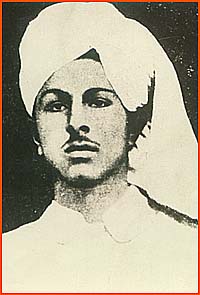
[FONT=Geneva, Arial, Sans-serif]Not check this one out on one of our Neo-Sikh-Akali website... [/FONT]
[FONT=Geneva, Arial, Sans-serif]http://www.sikh-history.com/sikhhist/personalities/bhagat.html[/FONT][FONT=Geneva, Arial, Sans-serif]
 [/FONT]
[FONT=Geneva, Arial, Sans-serif]Isn't this laughable ?? planting a beard on bhagat singh...pretty shoddy job too...[/FONT]
[FONT=Geneva, Arial, Sans-serif]Why are the Sikh in the west lying to their own children ?? Grow up guys lest you make yourselves the laughing stock of the world.[/FONT]
[FONT=Geneva, Arial, Sans-serif]- -[/FONT]
[FONT=Geneva, Arial, Sans-serif]- -[/FONT]
[FONT=Geneva, Arial, Sans-serif]Putting up pictures of Bhagat Singh in Guru-dwara's is an insult to the Guru-dwara as well as to the memory of a great martyr like Bhagat Singh. Those who do that respect neither Sikhism nor Bhagat. He should be respected for what he was and what he stood for. And he did stand for what he believed in till his last breath.[/FONT]
[FONT=Geneva, Arial, Sans-serif]It's not just Bhagat Singh the Akali and Neo-Sikh clowns are messing with. Look at how they treat the Dasam-Granth. Almost as if it doesn't exist. It might not be taken as a religious doctrine coz' Sikhism itself promoted scepticism through it's Guru's but the fact that it was written and that too by the Dasam-Pitaah is reason enough for it to be read. By all who believe in him. Or want to.[/FONT]
[FONT=Geneva, Arial, Sans-serif]There has been considerable controversy surrounding some of the writings attributed to him, with the suggestion being made that they fail to fit into some aspects of the Sikh religion. Macauliffe, a British officer, was mainly responsible for seeding the question, with an effort to separate Sikhs from Hindus.[/FONT]
[FONT=Geneva, Arial, Sans-serif]Now, all the cannons of purchased media are booming against Guru Gobind Singh and his writings and have been even labelled by some as an RSS-Brahminical propaganda. Every-thing Hindu is our enemy they proclaim. Superstitious we all cry.[/FONT]
[FONT=Geneva, Arial, Sans-serif]But if we find the Jutti of any Guru we start bowing from a 100 yards to pay our respect . If some body found some stone at some place and said that these are the stones which one of the Guru's used in Modi Khana, we build Big Gurdwawa's and Mela's are held and the stones are worshipped . If some body said that Guru Gobind Singh drank milk in a holed Jug we spend loads of money to pay homage.[/FONT]
[FONT=Geneva, Arial, Sans-serif]Now, if some poetic compositions, even if purely literary but definitely seen as Dasam-Guru's work, at some ocassions were collected by Bhai Mani Singh after so many years of the Guru's departure, what is the harm in it ?? Are these worthless than a Jutti and stones ?? [/FONT]
[FONT=Geneva, Arial, Sans-serif]The Hindu's too can challenge these Coffee-shop Sikh of Toronto and London. How can we abuse a Brahamin in the domocratic world . The Brahamana is considered preist by the Hindus. An equivalent of the Granthi. The Vedas contain lot of pronography but none of the Hindus or their shakraacharyas have ever raised the question of pronography and it's removal from Vedas .Let us see when ever such demand is raised how do the Hindu devouts rataliate. And if you ask me... I am sure they will give me all the reason in the world to continue to be proud of whatever I believe in. I am a real Sikh. A Sikh-Hindu. Searching for the truth. Maintaining a distance from those who claim to have found it.[/FONT]
[FONT=Geneva, Arial, Sans-serif]Thanks.[/FONT]